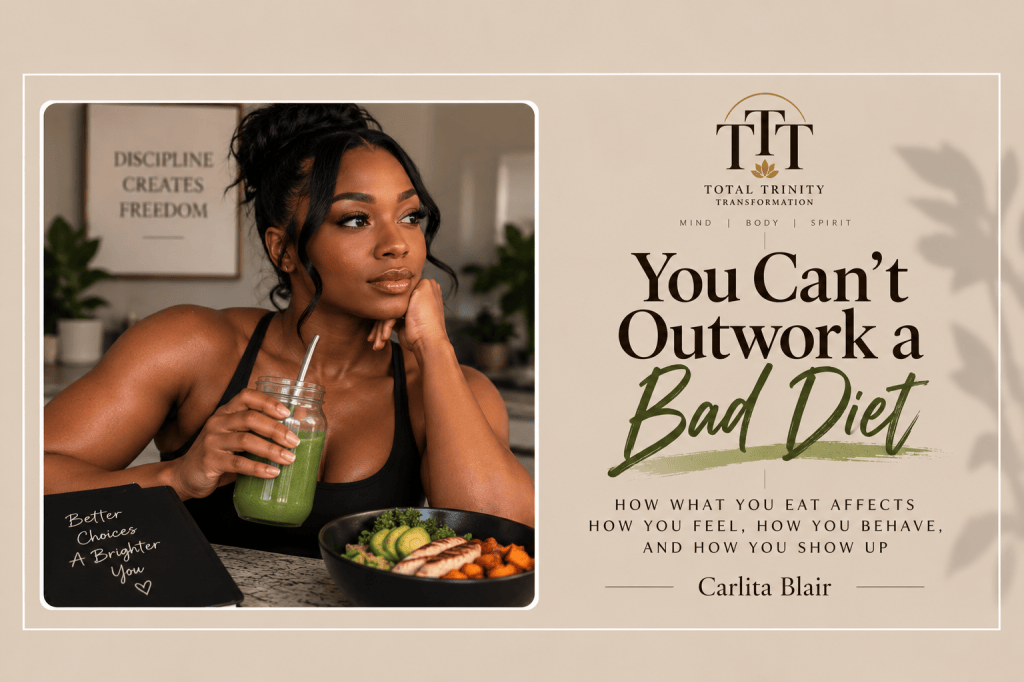
We’ve all heard it: you can’t outwork a bad diet.
Usually when we hear that, we think about it strictly in terms of weight loss. Calories in, calories out. How much you ate versus how much you exercised.
But I think it goes much deeper than that.
Because food isn’t just food.
For some of us, food is comfort. For others, it’s culture. It’s celebration. It’s family. It’s nostalgia. It’s the thing we reach for when we’re stressed, bored, tired, happy, sad—or just because it tastes good.
And none of those things automatically make food bad.
But the meaning we attach to food can either help us move toward the life we’re trying to create or keep us stuck in patterns that no longer serve us.
What You Eat Affects How You Show Up
One of the biggest things I’ve learned through years of training, bodybuilding, and simply paying attention to my own body is this:
What you consume affects how you feel. How you feel affects how you behave. And how you behave affects how you show up in the world.
That connection matters.
Think about how differently you move through your day when you feel energized, nourished, clearheaded, and strong versus when you feel sluggish, bloated, tired, or uncomfortable.
Your food choices don’t stop at your body.
They affect your energy. Your mood. Your workouts. Your patience. Your focus. Your ability to be present. They can even affect the energy you bring into the spaces you enter and the interactions you have with other people.
That’s why nutrition, to me, isn’t just about building a certain body.
It’s about supporting the life you want to live inside that body.
This Isn’t About Never Eating the Cookie
And this is where I think we sometimes make nutrition unnecessarily complicated.
You can eat the cookie.
Have the ice cream.
Go get the pizza.
Enjoy the food you love.
A lifestyle that requires you to fear food or believe you can never enjoy certain foods again probably isn’t going to feel sustainable for very long.
The lesson I’ve had to learn is moderation.
And whew—hearing the word moderation and actually learning how to practice it are two completely different things.
Because moderation requires awareness.
It requires being able to enjoy something without allowing the temporary pleasure of it to override what you know your body needs.
Sometimes that means having the food and enjoying every bite.
Sometimes that means realizing, I’ve had enough.
Both can be true.
Your Body Is Giving You Information
Instead of only asking:
“Does this taste good?”
Start asking:
“How does this make me feel?”
Pay attention.
How do you feel an hour after eating?
Are you energized?
Satisfied?
Clearheaded?
Or are you sluggish? Uncomfortable? Exhausted? Looking for another quick hit of something because the first thing didn’t actually nourish you?
Those little details are information.
Your body is communicating with you all day long, but you have to become quiet enough—and aware enough—to hear it.
That awareness can completely change the way you approach nutrition.
Because now you’re not choosing foods simply because someone told you they were “good” or “bad.”
You’re learning your body.
You’re noticing what supports you.
You’re noticing what doesn’t.
And you’re making choices from that awareness.
Nourishment Is an Act of Alignment
When you really understand that the food you consume is helping rebuild your body while also influencing how you feel and function, intentional eating starts to look different.
It becomes less about punishment.
Less about restriction.
Less about trying to be “good.”
And more about alignment.
Does the way I’m nourishing myself support the person I say I want to become?
Not perfectly or every single meal, but consistently. Ultimately, one meal isn’t going to determine your health, your body, or your progress, your patterns will. So have the foods you enjoy. Live your life. Celebrate. Eat the birthday cake. But also learn to listen to yourself.
Pay attention to what leaves you feeling nourished and energized versus what consistently leaves you feeling depleted. Your body gives you feedback every single day.
The question is: are you paying attention?


Leave a Reply