You hit a major milestone on your weight loss journey, so you celebrate by treating yourself to a nice meal and a celebratory desert and head home. You’re feeling amazing and decide that one more snack won’t hurt but before you know it, you’ve polished off 2 candy bars, a bag of chips, and a quart of ice cream. Tomorrow’s a new day you say, but the guilt slowly starts to creep in. You feel the cold tingles of anxiety begin to slither around your body while the whispers tell you, how stupid you are. Why did you eat all of that? You just ruined all your progress! You can’t do anything right! You might as well quit! On and on and on the whispers berate you until you feel so guilty that you eat more to soothe, but that only momentarily quiets the whispers, and once you’re done, it starts back up again.
Does any of that sound familiar? If so, just know you’re not alone. I’ve heard the negative whispers that accompanies emotional eating and felt the invading pins and needles of anxiety as well.
And to be honest it’s a battle I still have to fight although I am much better equipped to shut it down but there were times in the past that I was fighting an internal battle between my head and my body and my body won a lot of those days, but with a lot of self-work I was able to gain the upper hand, and today I’m going to give you 3 mindset shifts to staying on track with your fitness goals as an emotional eater. These are things I do daily, and I hope by sharing them with you, you find at least one that resonates with you.
So just so we’re all on the same page, emotional eating is eating in response to your emotions. You aim to repress negative emotions like sadness, anger, frustration, or boredom.
3 Tips to Stacking on Track
Tip #1 to staying on track as an emotional eater is to first understand that your emotions aren’t bad and then give yourself permission to feel them.
- We are energetic beings and as such our emotions are like guideposts that tell us something is going on within our energetic field and we need to take notice. Where we go wrong, and I used to do this a lot, is try to suppress the so-called negative feelings like sadness, anger, or frustration and attempt to only feel the more positive emotions like love and happiness, but what ends up happening is the suppression of the negative emotions starts to build up in the body temple, you begin to carry tension and become a ticking time bomb.
- Emotions are like water; they’re supposed to continuously flow through us. Think about it like this. If you turn on a garden hose the water flows freely, but when you obstruct that hose at any point, the water will stop, become backed up and eventually the hose will burst. That’s just like us. By blocking the flow of your emotions, you become backed up with low vibrating energy, and you will eventually explode and when you reach that point it’s usually the smallest thing that sends you over the edge. Like you blow up because someone forgot to put mild sauce in your bag at taco bell, when you’re really holding on to the anger from 8 days ago when you got into a fight with your friend and instead of feeling those emotions you attempted to push them away to shield yourself from the pain. In the end, you cause yourself greater pain by not releasing that energy. So again, understand that your emotions are not bad, they aren’t right or wrong they just are, and we need them.
The second part to tip #1 is to give yourself permission to feel your emotions.
- Again, as an emotional eater we have the tendency to suppress our emotions to avoid feeling anything, but we end up in a state of reactivity and creates additional stress. Our attempt to not feel our emotions is what drives us to try to self-soothe by eating, but by giving yourself permission to feel your emotions you can allow them to move through your body instead of becoming backed up.
- Your emotions have no conscious thought they are simply signals derived from situations and our environment that our body receives and then interprets. Once our mind and body receive the signal, we can then consciously feel the emotion trying to emerge within us an allow it to flow through us, without judgement. We are human, we are emotion filled beings, and we are in Earth school to learn how to navigate the world as we are and not be controlled by our emotions.
Tip #2 to staying on track as an emotional eater is to practice mindful eating.
- Your body is a sacred space and should be treated as such and the act of eating should be one that is done with careful consideration as to how you’re honoring your body. It’s not about depriving yourself or omitting certain or all food groups (unless you have an allergy) but being aware that not all foods are created equal and to give your body the best fuel you need to eat the best choices.
- Mindful eating means being fully attentive to your food and minimizing distractions while eating. Turn off the TV, silence your phone or put your phone in another room so that you can really focus on nourishing your body.
- Eating while distracted can and will cause you to eat more than you would if you otherwise paid attention. Be mindful of the tendency to eat as if you’re rushing as well. In this 30-minute lunch break society we can be tempted to eat fast as if we’re always rushing. So slow down when you can, be present with your food, and make smart food choices.
Tip #3 to staying on track as an emotional eater is to identify your triggers and apply a pattern interrupt.
The emotional eating cycle goes like this:
- Something happens that upsets or trigger you
- You then feel an overwhelming urge to eat
- You eat more than you know you should
- You feel guilty for overeating (cycle repeats)
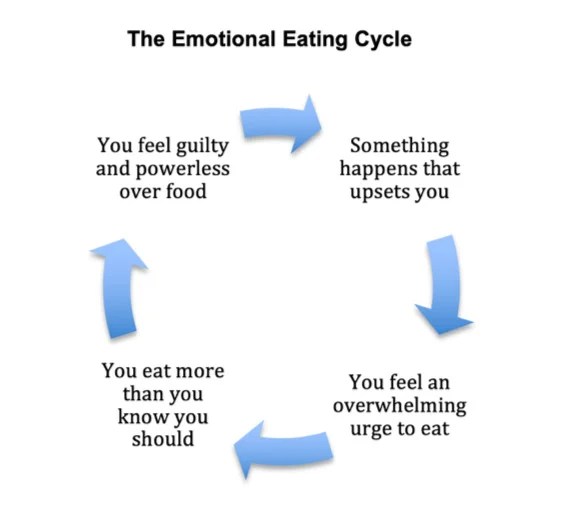
For example, your kids have been misbehaving all day which has stressed you out, you then go in the kitchen to grab something sugary to calm your nerves, once you get that first snack you then binge on cookies and chips, and after polishing off an entire sleeve of Oreos and a family bag of Dorito’s you start feeling guilty and internally beat yourself up and the cycle restarts.
The trigger in this case is the stress and overwhelm felt by misbehaving children, you then tried to relieve the stress by having a sugary snack ( the reason why we do this is because sugar releases the neurotransmitter serotonin which is a mood stabilizer) you then ate an entire sleeve of Oreos and a large bag of Doritos ,without conscious thought, then the guilt creeped in once you became conscious of your actions, and you started beating yourself up.
So, if you find that you consistently become stressed at a certain time, or by the same specific actions or people that is your trigger. Once you have identified the trigger it’s time to begin a pattern interrupt.
What is a Pattern Interrupt?

A pattern interrupt is anything that forces you to change your natural pattern of thought and action.
As creatures who thrive in and strive for autonomy and habits, emotional eating is something that has become habitual. You’re constantly firing the same neural pathways in the brain which will cause you to continue behaving in the same way, and in this case that means emotional eating. By implementing a pattern interrupt you break up the autonomy by becoming conscious of the actions you’re taking in that moment and that will create and fire new neural pathways changing your behavior from habitual and automatic to conscious and intentional.
Before engaging in emotional eating pause to check in with your body. Ask yourself what am I thinking, and am I really hungry? By pausing to check in with yourself you are breaking up the tendency to react in order to respond.
5 Additional Ways to Pattern Interrupt
- Go outside – removing yourself from the space, person, or situation gives your body and mind time to calm down and process your feelings.
- Place a red dot on your hand – this is a visual so that you can become conscious when you’re reaching for something to eat. It forces you to observe yourself and then you can check in with yourself to see if you are actually hungry or reacting to your circumstances.
- Count down from 10 – I know this may sound cliche’ but it works. By counting down you’re forcing yourself to change your current thought pattern which then allows you to observe what you’re thinking in the first place and then respond in a healthier way.
- Breathe – When we are stressed, we tend to held our breath further stimulating our fight or flight response. By taking slow, deep belly breaths you can then center and calm yourself down and the body will respond by stopping the release of the stress chemicals.
- Phone a friend – It doesn’t have to be a close friend, but should definitely be someone who is NOT a further trigger for you. This person should be someone who has a generally upbeat and positive attitude so that when you call them you let them talk about themselves to distract you from you. Fully engage with them and give them your undivided attention and their positive attitude by nature will rub off on you.
Take Away
Emotional eating is eating in response to your emotions as a way to repress negative feelings like sadness, anger, frustration, or boredom. Three ways to stay on track with your fitness goals as an emotional eater is to understand your emotions aren’t bad and give yourself permission to feel them, practice mindful eating, and to identify your triggers and apply a pattern interrupt. If emotional eating has become a habit just know with consistency all habits can be broken. I hope you found this helpful and I wish you guys nothing but peace, love, and light, this is Carlita blair, helping You skulpt your mind, one day at a time, with the help of the divine. Until next time, Peace.
 Total Trinity Transformation
Leave a comment